A typing tool that analyzes your keystrokes and tells you what to work on.
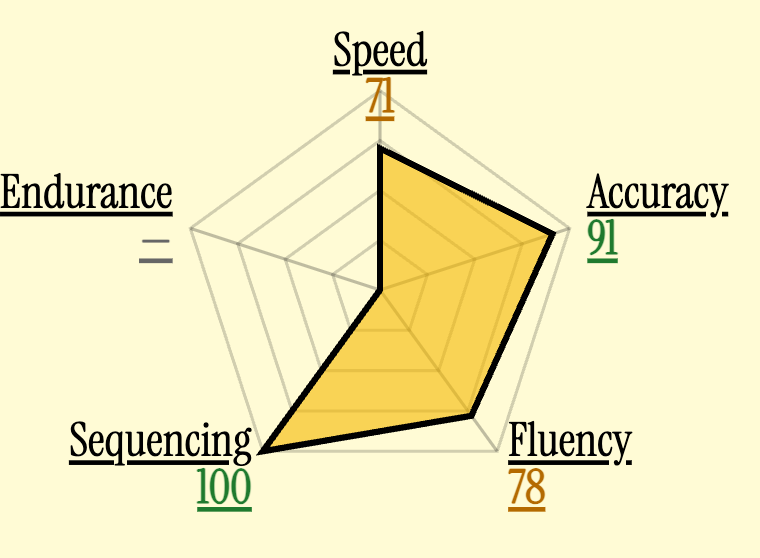
Most typing apps show your speed and accuracy and leave you to figure out the rest. Tachyboard tracks which keys you consistently hesitate onEvery keydown is timed against the previous one. Each key keeps an exponential moving average of its latency, weighted one quarter toward the newest run, and is judged against your own session average rather than a fixed benchmark. The claim that a key is slow gains confidence logarithmically as samples accumulate (Salthouse 1986)., which finger transitionsKey pairs and trigrams are timed from keydown to keydown and compared against your session average, trigrams against twice it. Only clean, intended transitions count. Pairs created by a typo, like a stray space, are filtered out so the coach never trains choreography you never meant to perform (Gentner 1983, Yamaguchi and Logan 2014). are slower than they should be, what kind of errors you tend to make, and how your performance changes across a sessionRuns are split into thirds. Warm up cost is how far your first third lags the rest of the run, fade is how far the final third drops. Both feed the Endurance axis of the Skill Map. Motor memory consolidates during even brief rests, which is one reason the shape of a session matters, not just its average (Mylonas 2024).. It uses that data to generate practice targeted at your actual weak points.
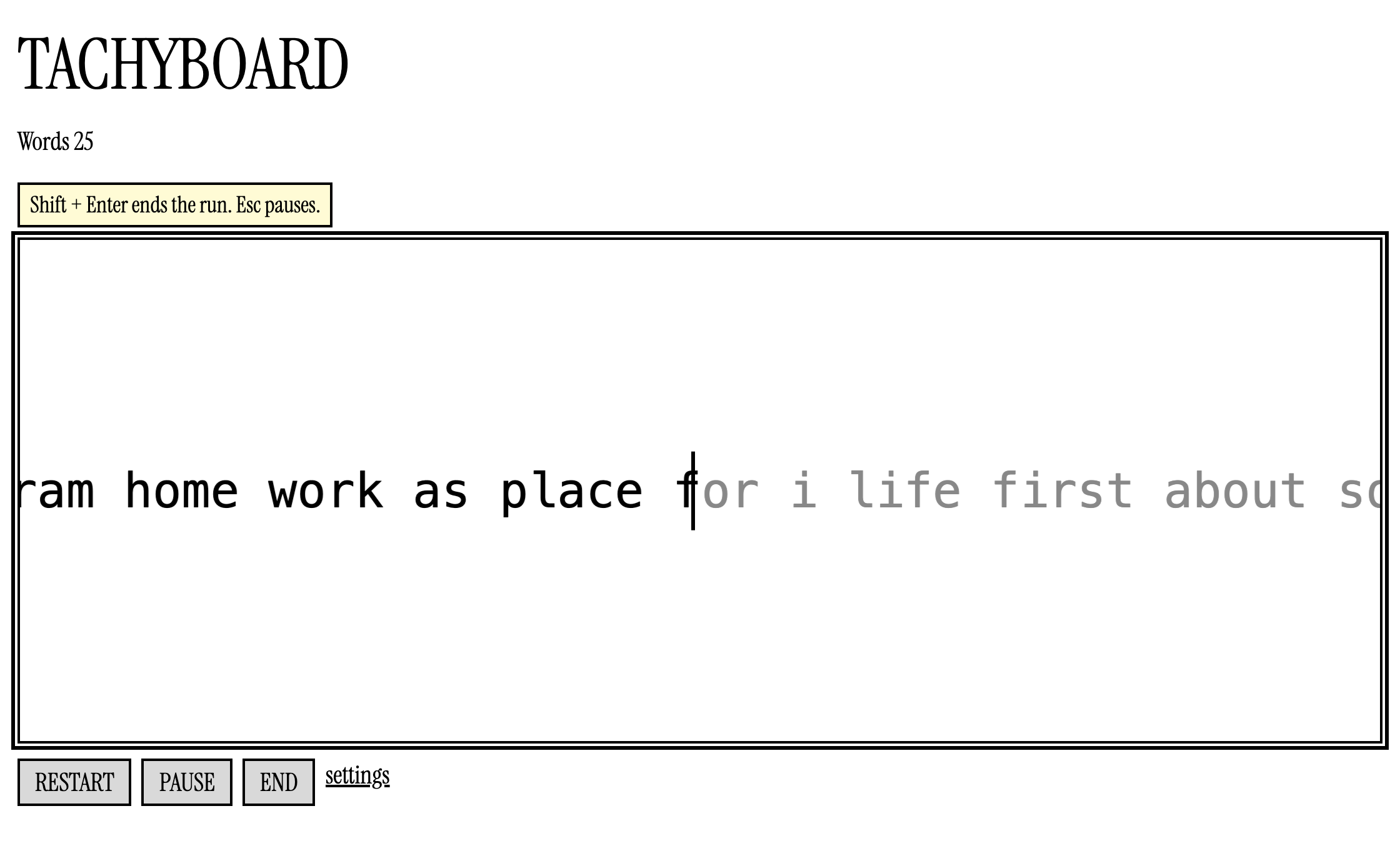
It only recommends practice when it has enough evidenceA weakness is only coached when its evidence is repeatable. Confidence grows with the logarithm of observed opportunities and saturates near thirty. Below about ten opportunities a target is treated as low confidence and cannot prove or disprove anything. Deliberate practice depends on working the right weakness, so the system stays silent rather than guessing (Ericsson, Krampe, and Tesch Romer 1993, Ericsson 2008). that a weakness is real and repeatable.
Tachyboard classifies errors into categories including anticipationThe wrong letter belongs within the next three letters of the same word. Skilled typing plans several keystrokes in parallel, so an upcoming letter can fire early. Because this is a heuristic it carries reduced confidence, and any concrete physical explanation outranks it (Yamaguchi and Logan 2014)., perseverationThe mirror of anticipation. The pressed letter already appeared within the last three positions of the word and lingered, intruding again. It is scored at the same reduced confidence and is likewise outranked by physical explanations such as an adjacent key press., transpositionTwo adjacent characters arrive in swapped order, a signature of two keystrokes planned together and released in the wrong sequence., double pressThe previous key repeats where it does not belong. Distinguished from a held key by comparing consecutive events, and from perseveration because it needs no earlier occurrence of the letter in the word, just the immediately preceding press., shift errorsThe right physical key with the wrong case or symbol. The classifier reads the actual state of the Shift key at each keydown, which separates a missed Shift, where a capital was due but Shift was late, from a late Shift release, where the previous capital was correct and Shift stayed down one character too long., and more. Each one is identified by comparing your actual keystroke against what was expected, using the physical layout of the keyboardEach key carries coordinates, a row, a hand, and a finger. A press within 1.05 key widths of the target counts as adjacent, within 1.55 as nearby. Same finger misses, row slips, column slips, and opposite hand errors are all measured from this geometry, and the most concrete geometric account always outranks the letter reuse heuristics..
Weaknesses are rankedThe rank blends three terms. An error rate component, capped and multiplied by sample confidence, carries 65 percent of the weight. A volume component that grows with the logarithm of total errors carries 35 percent. Confidence itself is the logarithm of opportunities normalized to saturate at thirty, so thin evidence discounts a high rate instead of hiding it. by how often they happen, how much they cost you, and how confident the system is that they are real patterns rather than one off events. A rare typo on a letter you barely use will not outweigh a recurring problem on a common letter.The scores below are computed with the real formula, not invented for the page.
Practice items are scheduledReview intervals expand with proof. A weakness proven acquired is probed again in five days, one that transfers into normal typing is rechecked in fourteen, and a regression pulls the item back within two days with a priority boost that jumps the queue. Spacing repetitions out this way produces more durable learning than massed drilling (Cepeda, Pashler, Vul, Wixted, and Rohrer 2006). so you do not keep drilling something you have already fixed. If a weakness comes back, it goes back into rotation.
Practice modes
Coach is your current training plan based on your profile. It draws from the data Tachyboard has gathered on your typing to put together a session aimed at what you need to work on right now.
Endless mixesInterleaving weak words with fresh material is deliberate contextual interference. Mixed practice feels harder than repeating one thing in a block but retains and transfers better. Fresh words for the same target follow schema theory, where varied practice of the same movement class generalizes (Shea and Morgan 1979, Schmidt 1975). your weak words with new material and recently trained words into a continuous practice session that adapts as you improve.
Ultradrill uses short burst sequencesBursts isolate one measured problem, a key, a pair, a trigram, or an error pattern, in short repeated sets. Each burst gives immediate knowledge of results while staying brief enough that the feedback guides learning rather than propping up performance (Salmoni, Schmidt, and Walter 1984). to target specific weak keys, pairs, trigrams, and error patterns. It is meant for isolated work on particular problems.
Time and Words are standard timed and word count modes. Quote pulls from public domain texts. All three get the same full analysis as the other modes.
Custom lets you paste your own text to practice.
Drill is generatedDrill text is never canned. Words are selected from a real dictionary because they contain the exact keys, transitions, or clusters under training, and a follow up drill draws fresh words for the same target so you practice the weakness rather than memorize a line. from your specific weaknesses and changes as your profile does.
Built by Will Chai.
Tachyboard does not use tracking. Accounts are optional and only used for syncing data between devices.
- Ericsson, Krampe, and Tesch Romer (1993). The role of deliberate practice in the acquisition of expert performance. Psychological Review.
- Ericsson (2008). Deliberate practice and acquisition of expert performance: a general overview. Academic Emergency Medicine. PMID 18778378.
- Yamaguchi and Logan (2014). Pushing typists back on the learning curve: contributions of multiple linguistic units in the acquisition of typing skill. Journal of Experimental Psychology: Learning, Memory, and Cognition. PMID 24933701.
- Salthouse (1986). Perceptual, cognitive, and motoric aspects of transcription typing. Psychological Bulletin, 99(3), 303-319.
- Gentner (1983). The acquisition of typewriting skill. Acta Psychologica, 54(1-3), 233-248.
- Dancey, Murphy, Andrew, and Yielder (2016). The effect of local vs remote experimental pain on motor learning and sensorimotor integration using a complex typing task. Pain, 157(8), 1682-1695. PMID 27023419.
- Salmoni, Schmidt, and Walter (1984). Knowledge of results and motor learning: a review and critical reappraisal. Psychological Bulletin, 95(3), 355-386.
- Schmidt (1975). A schema theory of discrete motor skill learning. Psychological Review, 82(4), 225-260.
- Shea and Morgan (1979). Contextual interference effects on the acquisition, retention, and transfer of a motor skill. Journal of Experimental Psychology: Human Learning and Memory, 5(2), 179-187.
- Mylonas, Schapiro, Verfaellie, Baxter, Vangel, Stickgold, and Manoach (2024). Maintenance of Procedural Motor Memory across Brief Rest Periods Requires the Hippocampus. Journal of Neuroscience, 44(14), e1839232024. PMID 38351000.
- Cepeda, Pashler, Vul, Wixted, and Rohrer (2006). Distributed practice in verbal recall tasks: A review and quantitative synthesis. Psychological Bulletin, 132(3), 354-380.